Contents8 sections
- Why do people call an online store?
- What does it take to answer a call about an order?
- What are the ways to run an online store's phone line?
- How do you decide who answers which call?
- What should an online store's call centre be integrated with?
- How do you know the store's line is working?
- What does a voice agent for an online store cost?
- Which online stores do not need a voice agent?
Before you buyARTICLE
A Call Centre for an Online Store: Which Calls It Takes and Who Should Answer
Online stores get calls for five reasons: order status, confirmation, returns, product questions and missed deliveries. For each one: what it takes to answer, who can answer it, how outsourcing, own operators and a voice agent compare, and why none of them works without access to orders.
Costa8 min read
Short answer
A call centre for an online store is the line that answers calls about orders: status, confirmation, returns, product questions, rescheduled delivery. Choose who runs it by call type rather than by price per minute: repeat order questions go to whoever can see the orders, a voice agent or an operator with integration; haggling, disputed returns and complaints stay with people. Without a link to the order system, any call centre can only say "I'll check and call back".
Key facts
- We estimate a first working turnkey voice operator, up to 20-30 simultaneous conversations, at $25-40k, with support at $1.5-3k a month; telephony, licences and hardware are separate (as of 9 October 2026).
- On a call to our demo on 9 October 2026 the voice agent answered 1.09 seconds after the caller stopped speaking.
A call centre for an online store nearly always starts from one problem: customers call and there is nothing to answer them with. An operator picks up, hears "where is my order", opens three windows, finds nothing and promises to call back. The pages that answer this search today are contractors' offers: a price per minute, a list of services, case studies. They leave out the main point: what the customer hears depends less on who picks up than on whether they can see the order.
Below are the five types of call an online store gets, what each takes to answer, three ways to run the line, and a rule for choosing.
Why do people call an online store?
Almost every call fits one of five reasons.
Order status. "Where is my order", "when will it arrive", "I didn't get a text". The most frequent call and the most repetitive. The answer sits in the order system or with the courier.
Order confirmation. An outbound call from the store: check the address, time, payment method, stock. For cash-on-delivery orders it is also how random and fake orders are caught before they are packed and shipped.
Returns and exchanges. How to return, where to bring it, when the money comes back. A simple return under the store's rules is a repeat question. A disputed one, a defect, damage in transit or a missed deadline, is not.
Product advice. Will it fit, how is it different, is the size in stock. This needs product knowledge, and the more complex the product, the more a person is needed.
Missed delivery. The courier could not get through, the customer calls the store to reschedule. The call is urgent: if nobody answers quickly, the order goes back to the warehouse.
What does it take to answer a call about an order?
Access to data. This is what separates a good store call centre from a bad one, and it is the part most often underestimated. To give a status you have to find the order by number or phone. To reschedule you have to see delivery slots and be allowed to change them. To answer about a return you need the return rules per category and the purchase date. To say whether a size is in stock you need inventory.
Without any of that it does not matter who answers: your operator, a contractor's or a voice agent. They record the question, promise a callback, and the customer writes to chat, calls again or leaves a review. So the first question when choosing a call centre is not the price per minute but integration: which order system, CRM and courier it is linked to, and what it can see and change there.
What are the ways to run an online store's phone line?
Own operators. Know the range, settle unusual cases, see orders in your system. The costs are hiring, training and shifts; nights and post-newsletter peaks are hard to cover without a large team.
Outsourcing. A contractor supplies operators, usually billed per minute, with setup and integration often priced separately. It covers hours and volume, but operators answer from a script and are weaker on complex product advice.
A voice agent. Software that answers by voice, understands the question in the caller's words, finds the order by number or phone and states the status, reschedules delivery, takes a return request under the rules. It takes every call at once, including at night and at peak. How it differs from voice broadcast and a scripted bot is covered in the note on call robots. It works only where there is data access and there are rules.
How do you decide who answers which call?
Pick an owner per call type, not one option for the whole line.
| Call type | What answering needs | Who takes it |
|---|---|---|
| Order status | Find the order, see status and date | Voice agent |
| Rescheduling, missed courier | Delivery slots, right to change them | Voice agent, if it can reach delivery |
| Order confirmation (outbound) | Address, time, payment method | Voice agent or operator |
| Simple return under the rules | Rules per category, purchase date | Voice agent, checked by staff |
| Product advice | Product knowledge, stock | Own operator; simple questions to the agent |
| Disputed return, defect, complaint | Authority to decide | A person |
| Wholesale, haggling | Authority to discount | A manager |
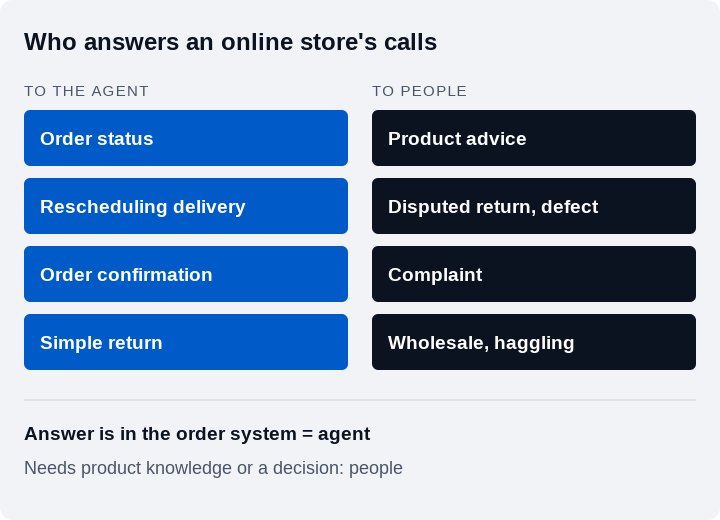
Rule: if the answer lies in the order system or the store's rules, give the call to whoever can see that system and picks up at once, usually a voice agent. If it needs product knowledge or a decision someone is accountable for, keep it with people, yours or a contractor's. If unsure, start with order status and missed deliveries: they are the most frequent and the most repetitive calls.
A typical picture on one call: a customer rings in the evening, the courier could not get through and they will be out tomorrow. The agent takes the order number or finds the order by phone, sees delivery is booked for tomorrow, offers the two nearest free slots, books the one chosen and confirms it aloud. The order record shows the new time and a note that it was moved at the customer's request. If no slots are free, the agent records the request and passes it to staff for the morning. Nowhere in the call does anyone say "I'll check and call back". How handover and lost calls work on a line in general is in the note on inbound call handling.
What should an online store's call centre be integrated with?
The minimum without which the line can only record questions: the order system or CRM (find by number and phone, status, contents, payment, and the call outcome written back); the courier or delivery service (status, slots, rescheduling); return rules per category in a form that can be applied without interpretation; inventory, if people call to ask what is in stock; and telephony, where the number you already publish stays the same. For a voice agent add the conversation rules: what it says word for word, what it never discusses, when and to whom it hands over. The questions we ask before an estimate are on the delivery page.
How do you know the store's line is working?
The number of calls taken says nothing. Count instead: "where is my order" calls per hundred orders (if high, the problem is notifications, not the call centre); the missed share by hour, especially after newsletters and during sales; missed-courier calls answered within minutes; repeat calls about the same order; and, for a voice agent, the share of calls closed without handover per call type. Take these before the change and three or four weeks after, on weeks with similar load.
What does a voice agent for an online store cost?
We estimate a first working turnkey version for 20-30 simultaneous conversations at $25-40k, with support at $1.5-3k a month, telephony and licences separate (as of 9 October 2026). The largest item inside is integration with orders and delivery: an agent that only takes requests costs noticeably less than one that finds the order and reschedules delivery itself. How the price adds up in the cloud and on your own servers is in the note on what a voice agent costs; what to test on a live call is in the note on AI phone agents; which calls to give a bot at all is in the note on voice bots for business.
Which online stores do not need a voice agent?
- A handful of calls a day. A manager with a phone and a good delivery and returns page is simpler.
- No access to orders. Until the order system exposes data through an API, the agent can only record questions.
- Mostly complex product advice. Electronics, made-to-order furniture and building materials are sold better by someone who knows the product; the agent helps on status and delivery.
- You expect the agent to settle disputed returns. It takes the request and passes it on; the decision on a defect stays with a person.
- You want the agent to pass as a person. Ours does not: it does not introduce itself as a bot, but answers honestly when asked.
You can hear how such an agent sounds on a line in the demo: it answers for a pest-control firm, a dental clinic and an estate agency. There is no shop there, but you can interrupt it, haggle and change the subject just the same. To go through your store's line by call type, leave a request on the Voice AI page.
Questions this raises
- Does an online store need a call centre?
- If customers call at least a few dozen times a day and most calls are about status, delivery and returns, yes: without a line those questions turn into reviews and refused orders. If calls are rare, a manager with a phone and a clear delivery and returns page will do.
- Can a voice agent tell a customer their order status?
- Yes, if it has access to orders: it finds the order by number or phone in the CRM or store system and states the status and delivery date. Without that integration, an agent and an operator alike can only record the question and promise a callback.
- Own operators or outsourcing for an online store?
- Own operators know the products and settle hard cases but cannot cover nights and peaks without a large team. Outsourcing covers hours and volume but answers from a script. Repeat order questions can go to a voice agent, with people kept for product advice, haggling and disputed returns.
- Will customers know they are not talking to a person?
- Often not from the voice. Our agent does not introduce itself as a bot at the start of a call, but answers honestly when asked directly and never claims to be human.