Contents8 sections
Before you buyARTICLE
Calling Customers: Which Calls to Give a Bot and Which to Keep
Calling customers is not one job but five: reminders, confirmations, surveys, win-back and upsell. Which of them to hand to a bot, which to keep for people, how to write the script, get the list in order and tell from the numbers that the calling works.
Costa6 min read
Short answer
Split customer calls by task, not by list. Reminders and confirmations go to a bot almost entirely. Surveys and win-back go to a bot that hands interested customers to a person. Upsell and conversations about large sums stay with people. Write the script from real customer answers, clean the list before launch, and measure success by the outcome of the call, not by the number of connects.
Key facts
- On a call to our demo on 9 October 2026 the AI agent answered 1.09 seconds after the caller stopped speaking.
- We estimate a first working AI agent for 20-30 simultaneous calls at $25-40k turnkey and $1.5-3k a month in support.
Calling customers usually starts with exporting a list and asking who will make the calls. The better first question is why we are calling. Reminding about an appointment, confirming a delivery, asking how it went, winning back someone who stopped buying, offering something more: five different calls with different lengths, answers and costs of getting it wrong. A bot does some of them better than a person because it does not tire and calls on time. Others a bot will spoil, because the customer needs a conversation, not a script.
The system that dials is covered separately in Auto dialer. This note is about the job itself: whom to call and what to say.
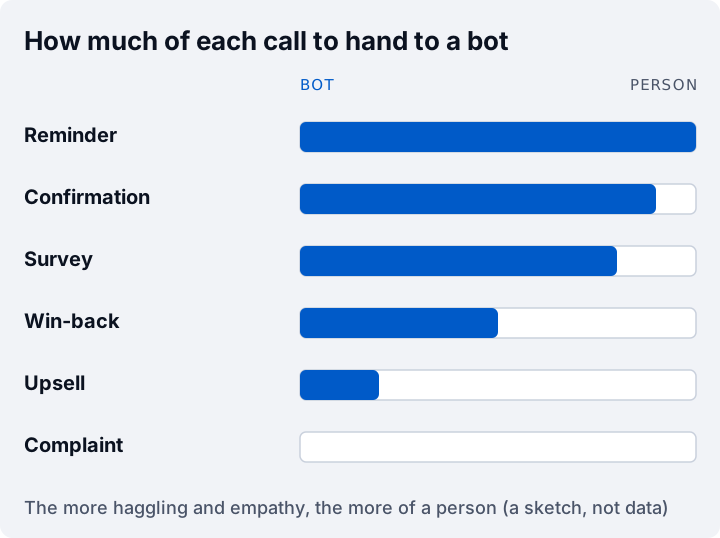
What jobs does customer calling cover?
Reminder. An appointment tomorrow, a subscription ending, a check-up due. Short, and the customer only needs to hear it.
Confirmation. Not just reminding but getting an answer: coming or not, delivery time fine, address correct. A freed slot goes straight to someone else.
Survey. A rating after a visit, a reason for cancelling, a good time for the next contact.
Win-back. The customer has not bought in a while. The call checks whether it is still relevant, and the customer nearly always asks questions back.
Upsell. Offering the next thing to someone who already bought. This is selling, with objections and haggling.
Which calls go to a bot and which to people?
The rule: give a bot the calls where the hardest customer answer fits your rules, and people the calls that need haggling, empathy or a decision the rules do not cover. For calls with questions, the bot here means an AI agent; the three kinds of voice are compared in Call robots compared.
| Task | Bot | Person | How to split |
|---|---|---|---|
| Reminder | All of it | Not needed | Recording, or an AI agent if the customer may ask |
| Confirm and reschedule | All of it | Hard cases | Agent reschedules from the calendar, exceptions to a person |
| Post-visit survey | All of it | Unhappy customers | Low score becomes a same-day task for a manager |
| Win-back | First call | Interested customers | Agent checks interest, hands hot ones over with context |
| Upsell | Booking the call | The conversation | A person handles terms and haggling |
| Complaint | Not needed | All of it | Straight to a person |
How do you write the script?
One goal per call. Confirming an appointment, not "confirming and also offering a cleaning".
The first sentence. Who is calling, from where and why, in one sentence. "Hello, this is the clinic on Main Street, calling to confirm your appointment tomorrow at ten" beats "Good afternoon, is now a good time?".
Answers to real questions. Listen to a dozen live calls first. Customers ask about parking, about bringing a child, about the price if something is added.
A way out to a person. Every script answers "put me through to someone" and "don't call me again". The second becomes a flag every later campaign respects.
Rules instead of lines. For an AI agent the script is a goal, rules and limits, not a tree of sentences: what it may promise, which prices it may quote, when to hand over.
How do you get the list ready?
Remove duplicates. Check consent: rules on marketing calls differ by market, so check with a lawyer where a service call ends and promotion begins. Flag everyone who asked not to be called, across all campaigns. Respect time zones. Add context: name, last visit, what they bought.
What does it look like in practice?
Take a dental clinic like the one in our demo. The example is illustrative. The evening before, the agent calls everyone booked for tomorrow: most confirm in one sentence, some reschedule to one of two free slots with the same dentist, some ask the price of adding a cleaning and get it from the clinic's price list. In the morning the receptionist sees a confirmed day rather than a call list. A week after the visit the agent runs a short survey, and an unhappy patient becomes a task for the manager with the recording attached. People keep the hard conversations: treatment plans, complaints, haggling.
On an outbound call our agent names the company and the purpose first and says it is an assistant; it never claims to be human. The pause before it answers was 1.09 seconds on our demo on 9 October 2026; where that second goes is in Where the second goes.
What shows the calling works?
Outcome for the task, counted in the CRM. Share of outcomes that reached the CRM without manual re-entry. Transfers to a person and their reasons. Early hang-ups, a sign the first sentence does not say who is calling and why. Opt-outs and complaints. Cost per outcome: minutes plus, for an AI agent, an implementation we estimate at $25-40k for a first version and $1.5-3k a month in support (details on the delivery page), divided by confirmed appointments or returning customers, not by calls.
When is a bot the wrong choice?
If you have dozens of customers, a person calls them better. If every customer is a large deal, it is account management, not a script. If there are no rules, write them first. And a complaint needs a person who can fix it.
A first campaign to run
Pick one task with more calls than people can make and a predictable answer, usually confirmations and reschedules. Write the script from real answers, clean the list, decide where outcomes go and run it on part of your customers. For which other calls to give a bot, see Voice bot for business; how we put an agent on your line is on the Voice AI page.
Questions this raises
- Which customer calls can a bot handle?
- Those where the customer's answer is predictable or fits your rules: reminders, confirmations, reschedules, short surveys. Win-back with handover of interested customers to a person. Upsell and large sums are better left to people.
- How do you write a customer calling script?
- Start with the goal of one call and a first sentence that says who is calling and why. Then answers to the questions customers actually ask. Always include what happens when the customer asks for a person or asks not to be called again.
- How do you know customer calling works?
- By the outcome: confirmed appointments, returning customers, survey answers that reached the CRM. Connect rate and call length show how the line works, not whether the calling paid off.
- Will the customer know a bot is calling?
- A recording and a scripted bot are obvious at once. An AI agent sounds natural, so ours tells the truth when asked directly that it is an AI and never claims to be human. A customer who wants a person gets a transfer or a callback.