

Contents8 sections
Before you buyARTICLE
A Robot for Calls: Three Different Things Sold Under One Name
Three different products are sold as a robot for calls: a voice broadcast that plays a recording, a scripted bot that listens for keywords, and an AI agent that understands people in their own words. What each one does on outbound and inbound calls, where each breaks, how the price is built and how to choose without overpaying.
Costa10 min read
Short answer
A robot for calls is a name for three different products. A voice broadcast plays a recorded message and understands keypresses or yes and no. A scripted bot follows a tree of lines and listens for keywords. An AI agent understands speech in the caller's own words and answers by your rules. Mass notifications need the first, short surveys the second, and any call where the customer asks questions needs the third.
Key facts
- ElevenLabs listed its Agents speech pipeline at $0.080 per minute beyond the included allowance on 9 October 2026.
- On a call to our demo on 9 October 2026 the AI agent answered 1.09 seconds after the caller stopped speaking.
- We estimate a first working AI agent for 20-30 simultaneous conversations at $25-40k, with support at $1.5-3k a month; hardware, telephony and licences are extra.
A robot for calls looks like a single product with different prices when you search for one. In practice three things are sold under the name, and they differ far more than in the price per minute: a voice broadcast that plays a recording, a scripted bot that listens for keywords, and an AI agent that understands what people say in their own words. The first page of results is mostly outbound dialling services, and each describes its own kind as the only one. Below: how the three differ on a live call, what each does on outbound and inbound, where each breaks, how the price is built, and the rule for choosing.
If hearing it is easier than reading, call our demo: the AI agent there books customers for a pest control service, a dental clinic and an estate agency.
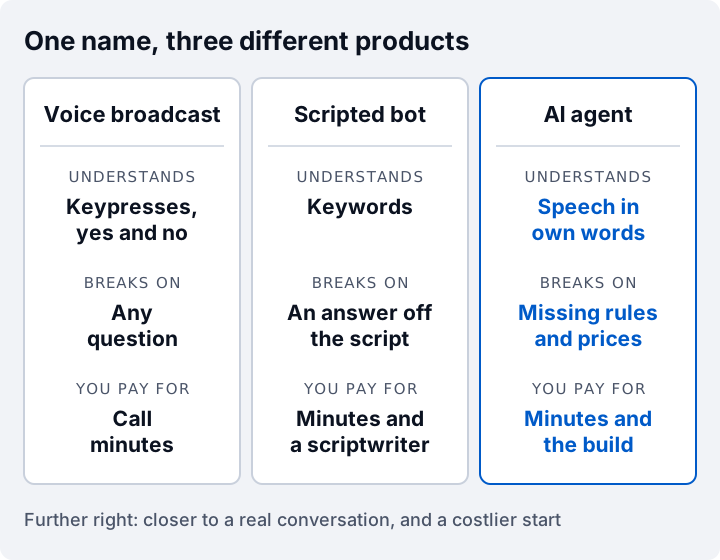
What kinds of call robots are there?
Voice broadcast. A recorded message the system plays to whoever picks up. Sometimes with a keypress or a short yes or no: "Press 1 to confirm your appointment." The oldest and cheapest kind. It does not talk; it announces.
Scripted bot. A tree of lines the conversation follows from question to question. The bot recognises the answer and looks for keywords in it: "interested" sends it down one branch, "not needed" down another, "call me back" schedules a retry. A person draws the script, usually in a visual builder. Most of the services on the first page work this way.
AI agent. A chain of speech recognition, a language model and voice synthesis. The agent does not pick a branch by a word; it understands the whole sentence, answers from your price list and rules, and decides what to ask next. It has a script too, but the script describes the goal of the call and its limits rather than every line. What an AI agent does on a real line is covered in our note on the AI phone agent.
The labels on vendor sites are mixed up. A "robot with artificial intelligence" can turn out to be a scripted bot with good recognition, and "smart autodialling" a broadcast with keypresses. The kind is decided not by the name but by one question: what happens when the customer says something the script does not contain.
What does a call robot do on outbound calls?
Outbound is home ground for the first two kinds, and the search results are mostly about them.
Notifications. A reminder about tomorrow's appointment, an order that is ready, a planned outage. No answer is needed, or a keypress is enough. A broadcast does this as well as anything and costs least.
Short surveys and list warming. Is the interest still there, how was the service, is the time convenient. Answers are predictable and branches few, so a scripted bot copes: it recognises yes, no, later, records the result and passes the warm ones to a salesperson.
A conversation where the customer asks questions. Rescheduling, checking terms, pushing back on price. The branches run out fast here. The customer says "what about Saturday, but after three, and I have a cat", and a scripted bot has nothing to hold on to. An AI agent takes the whole sentence, checks the schedule and the rules, and answers the point.
A word on dialling. Outbound services sell more than the voice: connection rates, retries, answering machine detection, number rotation, list upload. That is useful infrastructure and not worth rebuilding for mass campaigns. The voice that speaks after the call connects can be chosen separately.
What does a call robot do on inbound calls?
The search results say almost nothing about inbound, though for many businesses that is where the loss is. A call after hours, at lunch or at peak time goes to voicemail, and the person who called to buy rings a competitor ten minutes later.
On inbound a broadcast becomes a phone menu: "press 2". A scripted bot asks a few questions and records the answers, but trips on the customer's first question that is not in the tree. An inbound call almost always starts with the customer's question, not the robot's, which is why the gap between the kinds is widest there.
An AI agent on inbound handles the call the way a receptionist would: works out what is needed, quotes from the price list, offers a time, books it and writes the outcome to the CRM. If the question falls outside the rules, it does not invent an answer; it hands the call to a person or books a callback with the context already collected. What to listen for on such a call is in the same note on the AI phone agent.
How much does a call robot cost?
The bill has two parts, and their size differs by kind.
Minutes. Outbound services charge for talk time, and for a broadcast or a scripted bot a minute costs the vendor very little, so prices are low. An AI agent's minute costs more, because speech recognition, a language model and synthesis run on every one. ElevenLabs' Agents speech pipeline was listed at $0.080 a minute beyond the included allowance on 9 October 2026. The page does not say whether the language model is included.
Script and build. Someone has to draw a scripted bot's tree, test it on real answers and redo it when customers answer differently than expected. That is a scriptwriter's work, yours or the vendor's. An AI agent needs rules, a price list, access to the calendar and CRM, acceptance criteria and listening to calls after launch. We estimate a first working version for 20-30 simultaneous conversations at $25-40k and support at $1.5-3k a month, with hardware, telephony and licences extra.
If data must not leave for a cloud provider, the price changes again. The three delivery options, from the cloud to your own GPU servers, are set out in what a voice agent runs on and on the delivery page.
How do you choose the kind of call robot?
The rule is simple: choose by the hardest answer a customer will give on the call. If the customer does not need to answer, a broadcast is enough. If the answers fit a short list, a scripted bot is enough. If customers will ask their own questions, you need an AI agent, and saving on the minute will cost more in lost bookings.
| Voice broadcast | Scripted bot | AI agent | |
|---|---|---|---|
| Understands | Keypresses, yes and no | Keywords in the answer | The whole sentence, in own words |
| Best for | Notifications and reminders | Short surveys, list warming | Inbound, booking, price questions |
| Breaks on | Any customer question | An answer off the script | Missing rules and prices |
| Inbound | Phone menu | A few-question form | A receptionist's conversation |
| You pay for | Telephony minutes | Minutes and the script | Minutes and the build |
| Launch | Hours | Days | Weeks |
A mix is fine. Mass reminders go through a broadcast, the "reschedule" and "I have a question" answers go to an AI agent or a person, and inbound is handled by the agent end to end. The decision is made per type of call, not for the whole phone at once.
Outbound calling with recorded or automated voices is regulated in most countries, usually with consent rules for marketing calls. Check the rules for your market and your list with a lawyer before a campaign; inbound calls are a different matter, since the customer rang you.
How do you test a call robot before buying?
A vendor's demo is recorded in advance, and in it the customer always answers conveniently. Test with your own voice and words, one call per point.
- Answer off the script. To "does tomorrow at ten suit you?" reply "how much is it if I come on Saturday". A broadcast repeats the question, a scripted bot probably falls into its "didn't catch that" branch, and an AI agent should answer about price and come back to the time.
- Interrupt mid-sentence. People on real lines interrupt all the time. A robot that finishes its line regardless grates by the second minute.
- Pause and say "mm-hm". The robot should tell the end of a thought from a pause to think, and not take "mm-hm" as agreement to everything.
- Ask for a person. See what happens: a transfer, a callback, or an endless "let me help you". The last one is a complaint that has not been written yet.
- Open the record after the call. A robot that talked well but wrote nothing into the CRM saves less than it seems. Check that the name, number, request and outcome are where your team works with them.
Time the gap between your last word and the robot's first. On a call to our demo on 9 October 2026 the AI agent answered in 1.09 seconds; where that second goes is broken down in "Where the second goes". A three-second pause after every line breaks the conversation even when the answer is right.
Who does not need a call robot?
If calls are few and people pick them all up. Ten calls a day answered straight away will not get better with a robot. It earns its place where calls are lost: at night, at peak hours, when the receptionist is busy with someone at the desk.
If every call is a complex sale. A negotiation over a large contract, where the relationship and improvisation matter, is not a robot's job. It can set up the meeting and pass on the context, but leave the selling to a person.
If there are no rules to answer by. An AI agent answers from the price list, the calendar and the rules. If every price is worked out in the owner's head and the schedule lives in a paper diary, write the rules down first. Otherwise the agent either hands everything to a person or starts guessing.
Sorting your own calls
List the types of call you have: inbound price questions, bookings, reschedules, reminders, surveys. For each, note the hardest answer a customer actually gives on the line. That is the rule from the table, applied to your phone.
Then test on a live call rather than a presentation. Call our demo, interrupt the agent, go off script, ask for a person. If a conversation like that is what your line needs, the Voice AI page describes how we set it up, and the delivery page what each option costs.
Questions this raises
- How much does a robot for calls cost?
- It depends on the kind. Broadcast and scripted services charge for minutes of telephony, which are cheap. An AI agent costs more per minute because speech recognition, a language model and a voice run on every one; ElevenLabs listed its Agents pipeline at $0.080 a minute on 9 October 2026. An agent built around your rules and CRM is also a build: we estimate a first working version at $25-40k.
- What is the difference between a call robot and an autodialer?
- An autodialer is the way numbers get dialled from a list. Who speaks once the call connects is a separate question: a recording, a scripted bot, an AI agent, or a human the system hands the connected call to.
- Can a robot answer inbound calls too?
- Yes, and for many businesses that matters more than outbound. An inbound caller already wants to buy, and that is where it shows whether the robot understands a question in the caller's own words or keeps asking for yes or no.
- Will customers know they are talking to a robot?
- A broadcast or a scripted bot is recognisable from the first line. An AI agent often is not, which is why ours answers honestly that it is an AI when asked directly and never claims to be a person.