

Contents9 sections
- What does the price of a voice agent actually include?
- What does a voice agent cost in the cloud?
- What changes in the price if the data has to stay with you?
- What does the hardware cost if nothing may leave?
- Why not save money on the hardware?
- Can you rent first and buy later?
- Which option should you choose?
- Who is this kind of implementation not for?
- What else goes on the bill besides the server?
Before you buyARTICLE
What a Voice Agent Costs: Cloud, Your Perimeter, or Your Own Hardware
The price of a voice agent adds up differently in each of three delivery options: per minute in the cloud, a plain server plus minutes when the data stays with you, and GPU servers when nothing may leave. The budget for each, why cheap hardware falls short, and why you rent before you buy.
Costa11 min read
Short answer
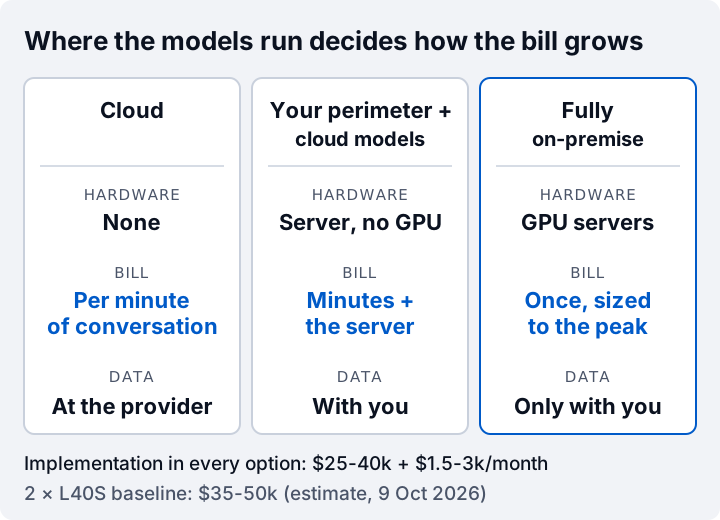
What a voice agent costs depends on where the models run. In the cloud you pay per minute of conversation and buy no hardware. If the data has to stay with you, a plain server without a GPU is added. If nothing may leave, you need GPU servers: for 20-30 simultaneous calls the baseline is two L40S cards at $35-50k on prices as of 9 October 2026. We estimate a turnkey first working version at $25-40k plus $1.5-3k a month for support.
Key facts
- A turnkey voice operator (Asterisk, telephony, the AI operator, integration, launch): first working version $25-40k, support $1.5-3k a month; hardware, carrier and licences are separate.
- Estimated server prices checked on 9 October 2026: a one-card pilot $20-35k, the 2 × L40S baseline $35-50k, 2 × RTX PRO 6000 $45-60k, 4 × L40S $55-75k, 4 × H200 NVL $160-200k, used A100 80 GB $8-12k per card.
- Renting 2 × L40S on demand ran from about $790 a month on Vast.ai to about $2,720 on AWS g6e for 730 hours, on prices checked 9 October 2026.
- The ElevenLabs agents speech pipeline cost $0.080 per minute beyond the included allowance on 9 October 2026.
- The call counts per configuration are assumptions to be confirmed by a load test with your own scenarios, not measurements.
The question usually arrives as a single line: what does a voice agent cost. The answers that come back are mostly one platform's price list, so much per minute or a bundle of minutes per quarter. That is an honest price for one particular purchase. In practice the cost of a voice agent adds up from different bills depending on where the models run: per minute in the cloud, a plain server plus minutes when the data has to stay with you, and GPU servers when nothing may leave. Below is what we count for each, with dates and sources.
In short: for 20-30 simultaneous calls we estimate a turnkey first working version at $25-40k and support at $1.5-3k a month. Hardware, carrier and licences are separate, and the hardware is where the options can differ by more than the whole implementation.
What does the price of a voice agent actually include?
A voice agent is not one program. It is a chain that runs in real time on every call, and the delivery page lists the links: telephony, speech recognition, a language model that decides what to say, a voice that says it, and the integrations that write the result where you work with it.
Somebody pays for each link. Telephony is a SIP trunk and numbers, billed by the carrier in every option. The three models in the middle are paid either per minute to a provider or once, as the hardware they live on. Integrations and scenarios are work: a prompt, knowledge, checks and tests for each scenario. And support, because scenarios change with the price list and the schedule, and someone has to listen to the calls.
So before comparing prices it helps to answer the question a per-minute price list does not: where must the models run, and where must the call recordings live.
What does a voice agent cost in the cloud?
The cloud is the option our demo runs on: the models sit with speech and language model providers, no hardware is needed, time to a first version is the shortest, and the voice and response time are what you hear on the call.
You pay per minute. As one public reference checked on 9 October 2026, the ElevenLabs agents speech pipeline cost $0.080 per minute beyond the included allowance. The page does not say whether the language model is included in that rate, so budget for it and for the carrier separately.
In the cloud the bill grows with minutes, not with the peak. A hundred calls a day at three minutes each is about 9,000 minutes a month, which at $0.08 puts the speech part at about $720 a month. That is arithmetic rather than a quote: put in your own minutes and add the model and the carrier.
What changes in the price if the data has to stay with you?
Then the middle option appears: telephony, call control, integrations and records live on your server, and the models are called over an API. The provider receives only what it needs to answer, and the recordings, transcripts and call cards stay with you.
This option needs a plain server without a GPU, and model minutes are paid as in the cloud. Voice and response time stay as in the demo, because the models are the same. Time to a first version is medium: besides the scenarios, the perimeter has to be deployed and connected on your side.
It is the most common answer to "the data stays with us", and it costs noticeably less than the fully on-premise option. Check with your lawyers whether your policy allows calls to external models from the perimeter. If it does, there is no GPU hardware to buy.
What does the hardware cost if nothing may leave?
The fully on-premise option is the whole chain on your servers. There is no per-minute bill for the models, but there is a GPU server, and it is sized by two things together.
Memory, because the recogniser, the language model, the synthesiser and the working state of every live conversation have to fit on the cards at once. And the moment when several callers finish a sentence at the same time, because that is when the model is asked for five or ten first sentences in parallel and every one of them is late if the card is busy. The number of calls per day says almost nothing about either.
These are the configurations on our delivery page, with server prices estimated on 9 October 2026 from card, memory and chassis listings. They are estimates, not quotes, and memory prices rose sharply over 2026.
| Configuration | Calls at once (assumed) | Whole server |
|---|---|---|
| Pilot: 1 × L40S 48 GB or 1 × RTX PRO 6000 96 GB | 5-10 / 10-20 | $20-35k |
| Baseline: 2 × L40S, 32 cores, 256 GB, 2 TB NVMe | 20-30 | $35-50k |
| Baseline with headroom: 2 × RTX PRO 6000 96 GB | 30-50 | $45-60k |
| Large: 4 × L40S or 4 × H200 NVL | 50-100+ | $55-75k / $160-200k |
| Budget, used: A100 80 GB | 15-25 per 2 cards | $8-12k per card |
The baseline assumes a compact conversational model of 7-14 billion parameters. A larger 30-70B model wants the third row even at the same number of calls. The used A100 is a real option for a tight budget, with two costs that belong on the same line as the price: no FP8, and a short warranty or none.
Every number in the middle column is an assumption. It depends on the models you end up with, and it gets replaced by a measured number before anything is bought. Voice and response time are checked again in this option too, because local models sound and answer differently from cloud ones, and where the second goes on your hardware has to be measured.
Why not save money on the hardware?
Three ways to save come to mind first, and each works on a desk but not on a line.
A gaming card. On a rack it runs into four problems. Less memory than a datacenter card, so a larger model or more callers do not fit. No ECC memory, which matters for a box that runs every day without anyone watching it. Cooling and power designed for a tower case, not for a dense server chassis in a room that is never switched off. And the licence: NVIDIA's GeForce driver terms do not permit datacenter deployment, which is a question your legal team will ask the week before go-live rather than the week before purchase.
A server without a GPU. A good box for the middle option, where the models are called over an API. As a home for the models themselves it is too slow: a pause of three seconds after every sentence is a broken conversation even if only two people are calling.
The smallest cloud GPU. Renting one card is a sensible way to start a pilot. The failure is treating the pilot result as the production result. One card that answers one tester in under a second can answer ten callers who stop talking together noticeably later, and the difference only appears under load.
Money saved on hardware is spent later on calls where the agent is silent too long. The caller does not know the server is busy. They hear a pause and decide they were not understood.
Can you rent first and buy later?
Yes, and that is what we recommend. For 2 × L40S on demand, 730 hours a month, the prices we checked on 9 October 2026 ranged from about $790 a month on Vast.ai, a marketplace of community hosts where availability varies, through about $1,150-1,590 on Runpod and about €2,150 on Scaleway, to about $2,720 on AWS, which has no two-card size and sells it as two one-card instances. CoreWeave sells only eight-card nodes. If the data must stay in Russia, the public price lists we checked did not offer L40S at all: the nearest with an open price was 2 × A100 at Immers.cloud for about 321,000 roubles a month, and Selectel, Yandex Cloud, Cloud.ru, Timeweb and MTS Cloud quote their cards on request.
A month of rent costs a small fraction of the box, and it buys the only number that matters: how the chain behaves when your peak arrives. The order we follow is short. Assemble the chain on rented cards. Run load tests with your scenarios and your real peak. Write the requirements for the server from the results. Buy after that.
In Russia that order matters twice, because the same cards cost roughly 1.5-2 times more and are usually made to order with 40-60 working days of lead time. A wrong purchase there costs a quarter, not a refund.
Which option should you choose?
The rule is simple. If recordings at a provider are acceptable, take the cloud: it is faster and cheaper to start. If the data has to stay with you but calling external models over an API is allowed, take your own perimeter with cloud models and a server without a GPU. If nothing may leave, take GPU servers, but rent them first for a month of load tests.
| If | Option | Hardware | How the bill grows |
|---|---|---|---|
| Recordings at a provider are fine, time matters | Cloud | None | With minutes of conversation |
| Data stays with you, API to models allowed | Your perimeter + cloud models | Plain server, no GPU | With minutes, plus the server once |
| Nothing may leave | Fully on-premise | GPU servers | Once, sized to the peak, plus power and support |
| Not sure where the data must live | Cloud as a pilot | None | Pilot, then recount |
A cloud pilot loses nothing: scenarios, knowledge and integrations move into the perimeter with you, and only the models under them change.
Who is this kind of implementation not for?
If you need an agent that dials a list with one question, a turnkey implementation is overpaying. Per-minute platforms with a builder exist for that, and their price is fair.
If you cannot yet describe what the agent should do on a call, it is too early to talk about price. Price and timeline come after the specification: which tasks, which systems the result goes into, what has to work at acceptance. Without it, a thousand and one wishes surface along the way.
If calls are few and the load is uneven, do not buy hardware even with strict data requirements: first check whether the middle option covers them. Cards idle twenty hours a day are the most expensive way to keep recordings in-house.
What else goes on the bill besides the server?
A GPU server for this job runs around the clock, because the line does. That means a rack with the power and cooling for it, a support contract that covers the cards rather than only the chassis, and a person who is told when it is unwell. It is the same question as who owns the assistant on a Tuesday, asked about a machine instead of a set of rules.
The carrier is also separate in every option: a SIP trunk, numbers, and if calls cross a mobile network, the two mobile legs that compress the voice and add delay.
Before counting, hear what the agent sounds like in the demo, and if the option is clear, describe a first delivery on the Voice AI page. The response time in the demo is the figure your load test has to beat on your own hardware.
Questions this raises
- How much does an AI voice agent cost?
- It depends on the delivery option. In the cloud you pay per minute for the models and the carrier and need no hardware. We estimate a turnkey first working version for 20-30 simultaneous calls at $25-40k, and support at $1.5-3k a month. A fully on-premise install adds GPU servers on top: the two-L40S baseline is $35-50k on prices as of 9 October 2026.
- Why does one platform charge cents a minute while an implementation costs tens of thousands?
- They are different purchases. A per-minute platform plan buys access to a builder where you write the scenarios yourself. A turnkey implementation is telephony, scenarios, integration with your systems, acceptance criteria and support. If the builder is enough for you, there is no reason to pay for an implementation.
- Can we run a voice agent on a gaming graphics card?
- For a demo on a desk, yes. For a production line it is the wrong tool: consumer cards have less memory, no ECC, cooling designed for a tower case rather than a rack, and NVIDIA's GeForce driver licence does not permit deployment in a datacenter.
- Is a CPU-only server enough?
- Yes, if the models are not on it. A server without a GPU is the right box for the middle option, where telephony, call control, integrations and data stay with you and the models are called over an API. Running recognition, a language model and synthesis for several live callers on processors alone does not answer fast enough.
- How many simultaneous calls does one server handle?
- Our working assumption is 20-30 for two L40S cards with a compact 7-14B parameter model. The real number depends on the recogniser, the language model and the synthesiser, and it is set by a load test with your scenarios before the purchase.