

Contents9 sections
- Which calls does a voice bot handle well?
- Which calls should stay with people?
- What does this look like in an actual business?
- How do you decide where to start?
- How does the bot hand a call to a person?
- What should you prepare before launch?
- What should you count after launch?
- What does it cost?
- Who is a voice bot not for yet?
Before you buyARTICLE
A voice bot for business: which calls to give it and which to keep
A voice bot pays back on certain calls, not across a whole business: calls that repeat, whose answer is already written down, and that end in a clear outcome. A breakdown by call type across three examples (pest control, a dental clinic, a property agency), what to prepare before launch and what to count afterwards.
Costa11 min read
Short answer
A voice bot pays back on calls that repeat, whose answer already sits in the price list or the rules, and that end in a clear outcome: a booking, an enquiry, a callback. Haggling, complaints and decisions a person is accountable for stay with people, and the bot gathers the context and hands the call over. Start with one or two such call types, not the whole line.
Key facts
- We estimate a first working version of a voice operator, turnkey, for up to 20-30 simultaneous conversations at $25-40k, with support at $1.5-3k a month; telephony, licences and hardware are separate (estimate as of 9 October 2026).
- On a call to our demo on 9 October 2026 the agent answered 1.09 seconds after the caller stopped speaking.
- Our demo runs three businesses (pest control, a dental clinic, a property agency) in four languages; the companies are fictional, the scenarios are real.
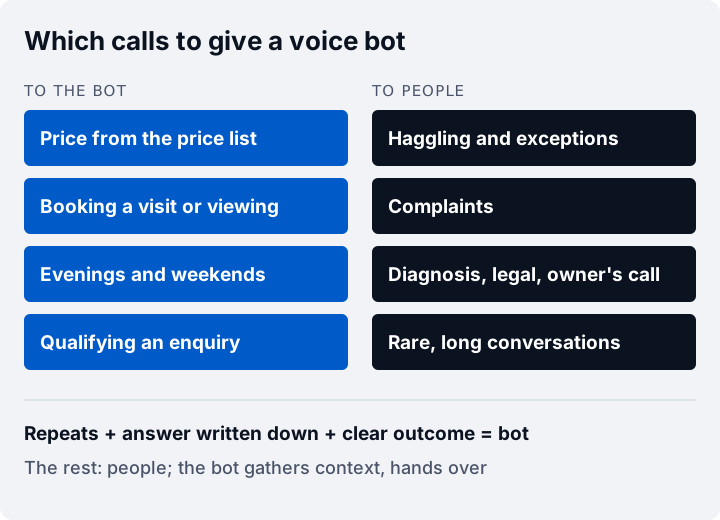
A voice bot does not pay back "in business" in general. It pays back on particular calls: the ones that repeat dozens of times a week, whose answer is already written in the price list or the rules, and that end in a clear outcome such as a booking, an enquiry or a callback. Everything else (haggling, complaints, decisions a person at your company is accountable for) is better left with people, with the bot doing only the preparation: who is calling, why, and what has been said.
Below is a breakdown by call type across the three businesses in our demo, a preparation list, and what to count once the bot is live.
Which calls does a voice bot handle well?
Three signs, and it is best when all three hold.
The call repeats. The same question dozens of times a week: how much, when can you come, where are you, what should I bring. On a question like that a bot quickly becomes more accurate than the average employee, because it does not tire, does not forget the conditions and does not mix up last year's prices with this year's.
The answer is written down. The price is calculated by a rule rather than invented mid-call; the schedule is in a system; the terms are in a document. If the answer lives only in the manager's head, the bot will not know it, and that is worth fixing before launch, not after.
The conversation has an outcome. A booked slot, an enquiry with address and phone number, a callback from a specialist. The outcome can be checked in the CRM, and it is also how you tell whether the bot works.
After-hours calls are a case of their own. Even if people cope during the day, in the evening and at weekends the call goes to voicemail or nowhere. There the bot is not competing with an employee but with a missed call, and that is usually the simplest first scenario.
Which calls should stay with people?
Haggling. Discounts, exceptions, "beat the competitor's price". If the price is decided in conversation, the bot has two honest moves: quote what the rules allow, or pass the offer to a person. It should never invent a discount, and our scenarios say outright that there are no other discounts.
Complaints and conflict. Someone calling to complain needs a person. The bot can take the call at night, record the substance and promise exactly what your rules promise, such as a callback in the morning, but the resolution stays with staff.
Decisions someone is accountable for. A diagnosis, a legal assessment, the owner's consent. The bot passes the question to whoever decides and does not pretend to have decided.
Rare, long conversations. A complex project discussed for an hour will not get shorter with a bot. It can book a meeting with a specialist and collect the basics.
What does this look like in an actual business?
Three examples from our demo. The companies are fictional, but the scenarios and rules work the way real ones do, and you can call each one to check what is said here.
Pest control
Calls often come in the evening and at weekends, and the question is nearly always the same: how much and when can you come. The bot asks what the pest is, how many rooms, city or suburbs, quotes from the price list, explains the difference between treatment methods, says how to prepare the flat and for how many hours to stay out, and books the nearest slot. For bedbugs it warns upfront that a second treatment after 10-14 days is almost always needed and is free under the guarantee: otherwise that question comes back as a complaint.
People keep offices, cafés and hostels, where the technician quotes on site, and haggling: the bot only offers the discounts in the rules. Call this scenario.
Dental clinic
Here the core is booking with the right dentist and acute pain. The bot asks what the problem is, works out who to book with, offers a time, quotes "from" prices from the list, and answers about instalments and insurance. A patient in acute pain is booked the same day, as the clinic's rules require.
People keep everything medical. The bot does not diagnose and does not say whether an implant is needed: it books a consultation. Complaints about treatment go to the front desk with the call card ready. Call this scenario.
Property agency
People call about a specific listing. The bot answers questions about the property (price, transport, floor, pets, deposit and fee) and qualifies the caller along the way: timing, budget, mortgage or not. The outcome is a booked viewing.
People keep the haggling: the owner decides, and the bot passes the offer on rather than promising a discount. And deals that need a lawyer's view. Call this scenario.
How do you decide where to start?
One table for the whole question, with the rule below it.
| Call type | What the bot does | Who takes it |
|---|---|---|
| Price question from the list | Asks the parameters, quotes by the rule | Bot |
| Booking a service or viewing | Offers a time, books, confirms | Bot |
| Evening and weekend call | Takes it, books or schedules a callback | Bot |
| Qualifying an enquiry | Collects budget, timing, address, contact | Bot, a manager checks the result |
| Haggling and exceptions | Quotes what is allowed, passes the offer on | Person |
| Complaint | Records the substance, promises a callback by the rules | Person |
| Medical or legal question | Books a consultation | Person |
The rule: if a call repeats, its answer is in the price list or the rules, and its outcome is a booking or an enquiry, give it to the bot. If the price is decided in conversation, the call is a complaint, or it needs a person accountable for the decision, keep it with people and have the bot gather context and hand over. If unsure, start with after-hours calls: there the bot competes with a missed call.
Start with one or two call types. Each scenario is rules, knowledge, checks and tests, and two well-built scenarios are worth more than ten tested only on a desk.
How does the bot hand a call to a person?
A handover is not the bot failing; it is part of the scenario and deserves as much design as a booking. A good handover sounds like this: the bot tells the caller it is connecting a colleague, or that a colleague will call back, and does not make them repeat everything. The person who picks up the call or the card already sees the name, number, the question and what the bot has already said.
A bad handover is a transfer to a general number where the caller explains again who they are and why they called. After that the bot looks like a needless extra step, even if it did everything right before the transfer.
At night there is no one to hand over to, and that is a rule too, not an exception. The bot records the substance and gives a callback time, and that promise has to match how your team really works in the morning. If nobody goes through the cards in the morning, the night scenario makes things worse: before, the caller simply did not get through; now they were promised a call that never came.
What should you prepare before launch?
Both the timeline and the price depend on this list. We ask about it before naming a budget, and it is the same as the specification section on our delivery page.
- Price rules, not just a price list. How the price is calculated, which discounts exist and which do not, when a specialist quotes. A price list without rules gets applied literally.
- Frequent questions with answers. Twenty or thirty questions actually asked on your line, with answers you are happy to hear from the bot word for word.
- CRM fields. What should be on the card after the call: name, phone, request, details, appointment time, outcome. A field not named in advance will not be there.
- Handover rules. When to transfer to a person, to whom, what to do at night when no one is in, and what the bot tells the caller at that moment.
- Off-limits topics. What the bot does not discuss: diagnoses, legal assessments, promises of dates not in the rules.
- Telephony. Which number, which PBX, who provides the SIP trunk. The number you already publish stays the same.
- Acceptance criteria. A list of conversations that must pass on your real line, including the hard ones (objections, interruptions, going off topic) and the acceptable response time.
What should you count after launch?
This is where most people go wrong: they count how many calls the bot took and celebrate a big number. Voicemail takes calls too. Count these instead.
- Share of calls with an outcome, per call type: booking, enquiry, callback. A call with no outcome is a call the bot did not finish.
- Handovers to people, and why. If the bot hands over half the calls of one type, that type is not for it, or the rules have a hole.
- After-hours calls before and after launch: how many used to be lost and how many now end in a booking.
- Errors in fields. Once a week, compare cards with call recordings. A wrong number on an enquiry is worse than a missed call, because nobody sees it.
- Response time under real load: median and 90th percentile from end of phrase to voice. Our demo measured 1.09 seconds on 9 October; where that second goes is in a separate note.
- Transcripts. In the first weeks they are worth reading, not just counting. Half the scenario fixes come from there.
What does it cost?
If we take on the whole chain (telephony, the operator, integration and launch), we estimate a first working version for 20-30 simultaneous conversations at $25-40k and support at $1.5-3k a month. Telephony, licences and, for the local option, hardware are separate. A bot that qualifies and transfers and a bot that sells and places orders cost differently: the second needs access to schedules and orders and considerably more testing.
How the price adds up in the cloud, in your own perimeter and on your own servers is in our note on what a voice agent costs. How an LLM voice bot differs from an IVR and a scripted decision-tree robot is in the note on robots for calls. How to test an agent on a live call before buying is in the note on the AI phone agent.
Who is a voice bot not for yet?
- If there are few calls. Five calls a day answered by the owner will not pay for a bot. Forwarding to a mobile is simpler.
- If most calls are haggling or complaints. The bot will hand them to people, and nothing is saved.
- If there are no rules and no one to write them. The bot works by your rules. If the price is decided afresh every time, agree on it internally first.
- If you expect to replace the whole team. The bot takes the repetitive part of the line, not the people who make decisions.
- If you need the bot to pass as a person. Ours does not: it does not announce itself as a bot at the start, but answers honestly when asked.
If your calls look like one of the three scenarios above, the simplest step is to call the demo and listen. If they look similar but not quite, you can leave a request on the Voice AI page and we will go through your line with the same questions.
Questions this raises
- What kind of business can use a voice bot?
- Any business with many similar inbound calls that end in a clear outcome: bookings, price and timing questions, call-out requests, questions about listings. What matters is not the industry but the share of such calls on the line. If most calls are haggling or complaints, a bot helps little.
- How much does a voice bot for business cost?
- We estimate a turnkey first working version for 20-30 simultaneous conversations at $25-40k, support at $1.5-3k a month, telephony and licences separate. Cloud platforms charge per minute. The price is broken down in our separate note on what a voice agent costs.
- Will the bot replace the receptionist or the operator?
- It takes the repetitive part: evening and weekend calls, price questions, bookings. Haggling, complaints and anything that needs a person's decision stay with people, and the bot hands those calls over with the context already collected.
- What needs preparing before a voice bot goes live?
- Price rules, not just a price list; a list of frequent questions with answers; the fields the bot must fill in the CRM; handover rules, including at night; the topics the bot does not discuss; and the criteria you will accept the work against.
- Will callers know they are talking to a bot?
- Often not by the voice. Our agent does not introduce itself as a bot at the start of a call, but it answers honestly when asked directly and never claims to be a person.