Contents8 sections
- What does an AI phone agent actually do on a call?
- How is an AI phone agent different from an IVR or an answering machine?
- Which five checks separate a working AI phone agent from a demo?
- What does an AI phone agent cost?
- Hosted or inside your own perimeter: which should you choose?
- Who is an AI phone agent not for?
- How should an AI phone agent be accepted before it goes live?
- Where to start
Before you buyARTICLE
An AI Phone Agent on a Real Line: What It Does and How to Test One
An AI phone agent answers calls, books, qualifies and hands over, then writes the call into your systems. What it does on a real line, what it costs per minute and per implementation, the five checks that separate a working one from a demo, and who should not buy one yet.
Costa9 min read
Short answer
An AI phone agent is software that answers and makes phone calls in a natural voice: it understands the caller, answers from your price list and rules, books or qualifies, hands over to a person when it should, and writes the result into your CRM. Judge one on a live call, not a list of features: answer within about a second, stop when interrupted, stay on the script, hand over cleanly, and never claim to be a person.
Key facts
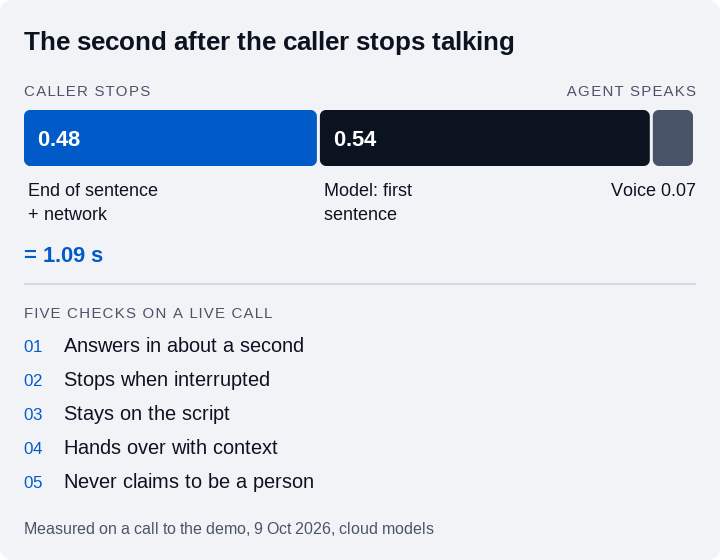
- On a call to our demo on 9 October 2026 the agent answered 1.09 seconds after the caller stopped talking: 0.48 s to detect the end of the sentence plus network, 0.54 s for the model's first sentence, 0.07 s to the first sound of the voice.
- Retell AI listed its voice infrastructure at $0.055 a minute, Claude 5 Sonnet at $0.064 a minute and call rates at $0.015 a minute on 9 October 2026.
- The ElevenLabs agents speech pipeline cost $0.080 a minute beyond the included allowance on 9 October 2026.
- We estimate a turnkey first working version for up to 20-30 simultaneous calls at $25-40k and support at $1.5-3k a month; hardware, carrier and licences are separate.
An AI phone agent picks up the call, talks to the caller in a natural voice, does what a receptionist or a first-line operator would do, and writes the result where your team works. Most pages that rank for "ai phone agent" are one vendor's product page or a list of ten tools with a paragraph each. Neither tells you what to listen for on a live call, which is the only place the difference shows. This guide covers what the agent actually does on a line, what it costs, the five checks we would run before signing anything, and who should not buy one yet.
You can skip the reading and call our demo agent first. It runs the same checks described below, in three businesses and four languages.
What does an AI phone agent actually do on a call?
Four jobs, and a real deployment usually starts with one or two of them.
Answers. It picks up every call, at two in the morning and during the lunch rush, and handles the routine part: opening hours, prices from your list, whether you cover a district, what a service includes. The answers come from your material, not from the model's general knowledge.
Books. It asks what is needed to book (the address, the size of the job, a convenient time), offers a slot, and confirms it back to the caller in words, including the phone number digit by digit.
Qualifies. For a sales line it finds out who is calling and why, how urgent it is and what budget they are working with, and passes a qualified lead on rather than a missed call.
Hands over. When the caller asks for a person, is upset, or asks something outside the agent's rules, it transfers the call or books a callback, and the person who picks it up already knows the name, the number and what was said.
After the call it fills in a card: name, phone, request, details, appointment, price quoted, outcome. On the Voice AI page this is the part that tends to matter most once the novelty wears off, because a call that leaves no record is a call nobody can act on.
How is an AI phone agent different from an IVR or an answering machine?
An IVR asks the caller to press 2. An answering machine asks them to leave a message that somebody may play back on Monday. Both put the work on the caller.
An AI phone agent holds a conversation. The caller says "we have cockroaches, how much is it" in their own words, and the agent asks the one question it needs, a flat or a house and how many bedrooms, and gives the price. The difference is not the voice. It is that the agent knows when the caller has finished speaking, does not stop at an "uh-huh", goes quiet when interrupted, and fills the pause when an answer takes a moment. That layer, conversation control, is what separates a call from a menu, and it is the first thing to listen for.
Which five checks separate a working AI phone agent from a demo?
Feature lists look the same across vendors. These five checks do not, and each takes a couple of minutes on a real call.
1. It answers within about a second. People expect a reply roughly a second after they pause. On a call to our demo on 9 October 2026 the agent spoke 1.09 seconds after the caller stopped: 0.48 s to detect the end of the sentence plus network, 0.54 s for the model's first sentence, 0.07 s to the first sound of the voice. Where the second goes breaks this down. An agent that waits two or three seconds after every sentence feels broken even when every answer is right.
2. It stops when you interrupt it. Start talking over it mid-sentence. It should go quiet and listen, and it should not stop dead because you said "mm-hm".
3. It stays on the script. Ask for a discount that does not exist, ask about a competitor, ask it to write you a poem. A good agent declines politely and returns to the booking. A weak model agrees to things your business does not offer, and you find out from an angry customer.
4. It hands over cleanly. Ask for a human. Then check what the human receives: the caller's name, number and the gist of the call, or nothing.
5. It says it is an AI. Ask it directly. Ours answers honestly and never claims to be a person. An agent that pretends to be human turns every caller who realises it into a complaint.
Then run the same checks over a mobile phone, not only in a browser. A call that crosses two mobile networks loses a lot of the audio, and short answers like a house number suffer most. Two mobile legs explains what the codecs do. Our demo has a switch that simulates it.
What does an AI phone agent cost?
There are two bills, and pages that rank for this question usually show only the first.
The minutes. Hosted platforms charge per minute of conversation, often split by component. On 9 October 2026 Retell AI's pricing page listed voice infrastructure at $0.055 a minute, Claude 5 Sonnet as the language model at $0.064 a minute and call rates at $0.015 a minute (the page does not say for which country). The ElevenLabs agents speech pipeline was $0.080 a minute beyond the included allowance; that page does not say whether the language model is included. A hundred calls a day at three minutes each is about 9,000 minutes a month. At Retell's three listed components together, $0.134 a minute, that is about $1,200 a month. That is our arithmetic on a list price, not a quote, and the model you pick moves it.
The implementation. The minutes buy access to a builder. Somebody still has to write the scenarios, connect the telephony, integrate the CRM and calendar, agree what "done" means and listen to calls afterwards. For a turnkey operator handling up to 20-30 simultaneous calls we estimate a first working version at $25-40k and support at $1.5-3k a month, with hardware, the carrier and licences on top. What a voice agent costs goes through the three delivery options in detail.
If the builder is enough for you, because you have one simple scenario and someone in-house to maintain it, there is no reason to pay for an implementation.
Hosted or inside your own perimeter: which should you choose?
The question "where do the models run, and where do the recordings live" decides the timeline, the budget and the hardware. There are three answers, and the delivery page compares them side by side.
| Option | Where the models run | Where recordings live | Hardware | Time to first version |
|---|---|---|---|---|
| Hosted | At the providers | At the provider | None | Fastest |
| Your perimeter, cloud models | At the providers, over an API | With you | A plain server, no GPU | Medium |
| Fully on-premise | On your GPU servers | Only with you | GPU servers sized to the peak | Longest |
The decision rule. If keeping recordings at a provider is acceptable, start hosted: it is the fastest route, and the voice and response time are what you hear in our demo. If the data has to stay with you but calling external models from the perimeter is allowed, take the middle option: one plain server and no GPUs to buy. Only if nothing may leave the building do you need the fully on-premise install, and then you rent the hardware for a load test before you buy it.
The on-premise option is sized by peak load, not calls per day: the number of callers who finish a sentence in the same second and wait for an answer. Two L40S cards are our starting point for 20-30 simultaneous calls, at an estimated $35-50k on prices as of 9 October 2026. That number of calls is an assumption until a load test with your scenarios replaces it.
Who is an AI phone agent not for?
A line that rings five times a day. If the calls are few and a person already answers them well, the agent saves little and adds a system to maintain. A good voicemail and a callback rule are cheaper.
Calls that are mostly judgement. Negotiating a contract, delivering bad news, handling a complaint that needs a decision only a manager can make. The agent can take the details and book the call with the right person. It should not try to do that person's job.
A business without written rules. The agent answers from your price list, your service area and your handover rules. If those exist only in somebody's head, write them down first. That is useful work even if you never buy an agent, and without it no agent will behave.
A team that will not listen to the calls. Scenarios drift as prices and schedules change. Someone has to listen to a sample of calls every week and correct the agent. If nobody will, the agent slowly starts saying last quarter's prices.
How should an AI phone agent be accepted before it goes live?
Fix the criteria before any work starts, so that "done" means the same thing to both sides. The ones we use:
- Scenarios. An agreed list of conversations passes end to end on your real line, including the hard ones: objections, interruptions, changing the subject.
- Voice. Quality is judged on your telephony, not in a studio or a browser.
- Response time. Median and 90th percentile from the end of the caller's sentence to the agent's voice, under an agreed load. "Median no longer than 1.5 seconds" is a reasonable line to write down.
- Interruption. The agent goes quiet when interrupted and does not stop for an "uh-huh".
- Data. The fields after the call are right (name, phone, request, date, outcome) and land where you work with them.
Where to start
Call the demo and run the five checks yourself: interrupt it, push it off the script, ask for a person, then turn on the two-mobile-legs line and try again. If that is the kind of agent you want on your line, the Voice AI page is where to tell us about your calls, and the delivery page lists the questions we will ask first.
Questions this raises
- What is an AI phone agent?
- Software that holds a phone conversation in a natural voice. It hears the caller, decides what to say from your price list and rules, says it, and records the outcome: a booking, a qualified lead, a callback, or a handover to a person with the context collected.
- Can callers tell they are talking to an AI phone agent?
- Often not from the voice alone, which is why ours says it is an AI when asked and never claims to be a person. Pretending to be a person is a complaint waiting to be written, and in a growing number of places it is a legal question as well.
- How much does an AI phone agent cost per minute?
- Hosted platforms bill by the minute and by component. On 9 October 2026 Retell AI listed $0.055 a minute for voice infrastructure, $0.064 for Claude 5 Sonnet and $0.015 for calls; the ElevenLabs agents pipeline was $0.080 a minute beyond the allowance. The implementation around the minutes, scenarios and integrations, is a separate budget.
- What happens when the AI phone agent does not know the answer?
- A good one says so and hands over: it transfers the call or books a callback, and passes the person the name, the number and what was already said. A bad one makes something up. Test this on purpose before you buy.
- Can an AI phone agent run on our own servers?
- Yes. The telephony, call control and records can sit on a plain server inside your perimeter while the models are called over an API, or the whole chain, models included, can run on your own GPU servers. The second needs hardware sized to your peak load.
- How do I test an AI phone agent before buying?
- Call it yourself and try to break it: interrupt it, change the subject, ask for a discount that does not exist, ask something it cannot know, ask for a human. Then check what landed in the CRM. Fix these as acceptance criteria before any work starts.