

Contents8 sections
- How is a robot operator different from an IVR or voice broadcast?
- Which calls does a robot operator run on its own?
- Where does it assist people instead of replacing them?
- How do you split the line between the robot and operators?
- How do you check its quality?
- What does a robot operator cost?
- Who is it not for?
- Where to begin
Before you buyARTICLE
A Robot Operator on the Phone Line: What It Takes Over and What It Leaves to People
A robot operator on a phone line does not replace the call centre. It takes the calls that repeat: price questions, bookings, reschedules, reminders. Here is, stage by stage, what the robot runs, what people keep, how to check quality from the transcripts and what the split costs.
Costa5 min read
Short answer
A robot operator is a voice agent that takes and makes calls instead of an operator: it answers questions from the price list, books, reschedules, reminds and writes the outcome into the CRM. It replaces people on repetitive calls with a clear outcome and assists them on the rest by gathering context and handing the call over when the question falls outside the rules. Complaints, haggling and exceptions stay with people.
Key facts
- On a call to our demo on 9 October 2026 the agent answered 1.09 seconds after the caller stopped speaking: 0.48 s to detect the end of speech, 0.54 s for the model's first sentence, 0.07 s to first audio.
- We estimate a first working voice operator, turnkey, for up to 20-30 simultaneous calls at $25-40k, with support at $1.5-3k a month; telephony, licences and hardware are extra (as of 9 October 2026).
- The ElevenLabs Agents speech pipeline cost $0.080 per minute beyond the included allowance on 9 October 2026.
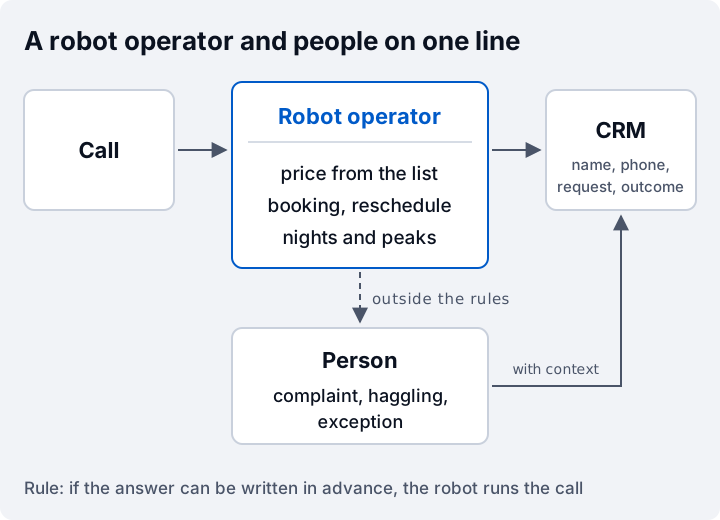
A robot operator sounds like a replacement for the call centre: switch it on and the people are no longer needed. On a real line a different split works. The robot takes the calls that repeat and end in a clear outcome: a price question, a booking, a reschedule, a reminder. A person gets what needs a decision: a complaint, a negotiation, an exception, and gets it with the context already gathered.
You can hear such a call in our demo, where the agent takes calls for a pest-control firm, a dental clinic and an estate agency.
How is a robot operator different from an IVR or voice broadcast?
Voice broadcast plays a recording, an IVR asks the caller to press a digit, a scripted bot listens for keywords. All three make the caller adapt: answer briefly and stay inside the branches someone drew in advance. We compared the three in the note on call robots.
A robot operator in the sense used here is built differently. Speech recognition turns the voice into text, a language model understands the whole sentence and decides what to answer by your rules, and speech synthesis says it. The caller speaks in their own words, interrupts, asks two things at once, and the robot runs the call the way an operator would. When a question falls outside the rules it does not invent an answer; it hands the call over.
Which calls does a robot operator run on its own?
The first question and the price. The answer is in the price list or the property base, so the robot gives it straight away and asks the clarifying questions a receptionist would: size, type of service, date.
Bookings and reschedules. It checks free slots, offers options, books, and on a reschedule finds the existing booking and moves it.
Reminders and confirmations. An outbound call the day before with "are you coming?", and a reschedule on the spot if the answer is "can we do Saturday".
Evenings, nights, weekends and peaks. Calls that used to go to voicemail or "all our operators are busy". The robot takes them all at once.
Writing up the outcome. After each call it fills in the CRM card: name, phone, request, details, agreement, price, outcome.
Where does it assist people instead of replacing them?
Complaints. It listens, asks what happened and when, and books a callback marked as a complaint with a summary, so nobody starts with "tell me again".
Haggling and discounts outside the rules. It does not invent a discount; it records what the caller asks for and passes it to someone who can decide.
Exceptions. An urgent night call-out, a patient in acute pain, a property that is not in the base. The robot recognises the case by your rules and transfers at once.
"Can I speak to a person?" The caller gets one: a transfer during hours, a callback after hours.
How do you split the line between the robot and operators?
The rule: the robot runs a call when the right answer can be written down in advance; a person runs it when the answer needs a decision in the moment.
| Call type | Who runs it | What the other does |
|---|---|---|
| Price question from the list | Robot | Person adds rules when the question changes |
| Booking and reschedule | Robot | Person sees the booking in the CRM |
| Reminder and confirmation | Robot | Person gets the list of refusals |
| Night and peak calls | Robot | Person calls back the hard ones in the morning |
| Complaint | Person | Robot listens, summarises, books a callback |
| Haggling, special discount | Person | Robot records the request |
| Exception to the rules | Person | Robot recognises it and transfers at once |
How do you check its quality?
Every call is recorded and transcribed, so checking is more complete than with people: a weekly sample across call types, every handover (either a correctly spotted exception or a gap in the rules), every call that ended without an outcome, and the response pause. On our demo it was 1.09 seconds; where the second goes breaks it down.
What does a robot operator cost?
Minutes and implementation. Each minute runs recognition, a language model and synthesis, so it costs more than a broadcast minute; the ElevenLabs Agents speech pipeline was $0.080 a minute beyond the allowance on 9 October 2026, and the page does not say whether the language model is included. A first working version for 20-30 simultaneous calls we estimate at $25-40k turnkey plus $1.5-3k a month, telephony, licences and hardware extra. If recordings must not leave your perimeter, see what an AI voice agent costs and the delivery page.
Who is it not for?
If there are few calls and people answer them all. If almost every call needs a decision. If the rules are not written down yet. And if what you need is cold advertising calls without consent: that is a legal question, not a choice of robot.
Where to begin
Take one week of calls, sort them by the table above, then call the demo and test it with your own voice. What else to test is in the note on AI phone agents, and what makes a robot genuinely smart is in the note on smart voice robots. How we put one on your line is on the Voice AI page.
Questions this raises
- What is a robot operator?
- A voice agent that runs phone calls instead of an operator: it understands what the caller says, answers by your rules and price list, books, reschedules or hands the call to a person, and writes the outcome into the CRM.
- Can a robot operator replace a call centre completely?
- Usually not, and it should not. It takes the repetitive calls with a clear outcome and passes complaints, haggling and exceptions to people along with the context it gathered. You need fewer people at peak hours and at night, but not none.
- How do you check a robot operator's quality?
- The way you check an operator, only more completely: every call is recorded and transcribed. Listen to a weekly sample, review every handover and every call that ended without an outcome, and add the rules the robot got wrong.
- Will callers know they are talking to a robot?
- Often not, if it answers quickly and understands free speech. Ours tells the truth when asked directly that it is an AI, and never claims to be a person.