

Contents9 sections
- How are inbound calls handled today?
- Where do inbound calls get lost?
- Which numbers show that call handling works?
- How do you count missed calls by hour?
- What does a voice agent take on, and what stays with people?
- How do you choose a way to handle inbound calls?
- How does the agent hand a call to a person?
- How do you launch a voice agent on an inbound line?
- Who does not need a voice agent on inbound calls?
Before you buyARTICLE
Inbound Call Handling: Where Calls Get Lost and Who Should Take Them
Inbound call handling is usually discussed as a call script. Calls are mostly lost before the script starts: at night, at peak and when nobody can pick up. Four ways to take calls, three numbers that show the losses, and how a voice agent shares the line with people.
Costa9 min read
Short answer
Inbound call handling is the path of a call from the first ring to an outcome: a booking, an order, an answer or a handover to the right person. Calls are lost less often because of a weak script than because nobody picks up: in the evening, at weekends and at peak hours. Start with three numbers, the share of missed calls, time to answer and the share of calls with an outcome, and only then choose between a person, outsourcing, an IVR and a voice agent.
Key facts
- On a call to our demo on 9 October 2026 the voice agent answered 1.09 seconds after the caller stopped speaking.
- We estimate a first working turnkey voice operator, up to 20-30 simultaneous conversations, at $25-40k, with support at $1.5-3k a month; telephony, licences and hardware are separate (as of 9 October 2026).
Inbound call handling is everything that happens to a call from the first ring to an outcome: who picks up, what they say, where the result is recorded and who gets the call when it cannot be settled on the spot. Most writing on the subject is about the script: how to greet, how to find the need, how to close. The script matters, but calls are usually lost before it comes into play. Nobody picks up: at eight in the evening, on Saturday, on Monday morning when everyone calls at once.
Below are four ways to take inbound calls, three numbers that show how many calls you lose today, and how a voice agent shares the line with people without replacing them.
How are inbound calls handled today?
Almost every company uses one of four ways, or a mix.
A person on the phone. A receptionist, an administrator, a manager, sometimes the owner. Knows the company best and can settle an unusual question. The weak spots are well known: one person cannot take two calls at once, goes to lunch, falls ill, and is gone after six.
An outsourced call centre. The contractor's operators answer from your script. It covers hours and peaks if the contract says so, usually billed per minute. The weak spot is product knowledge: the operator answers from the script, and everything outside it becomes "we'll call you back".
An IVR. "Press one to...". Good at routing calls to departments and answering very simple questions with a recorded phrase. It does not settle the question itself: it only routes, and someone still has to pick up.
A voice agent. Software that listens, understands the question in the caller's own words, answers by your rules and price list and writes the outcome into the CRM. How it differs from voice broadcast and a scripted bot is covered in our note on call robots. Its strength is that it has no working hours and no queue: it takes every call at once, and the tenth simultaneous call is no different from the first. Its weakness is that it only works where rules exist.
Where do inbound calls get lost?
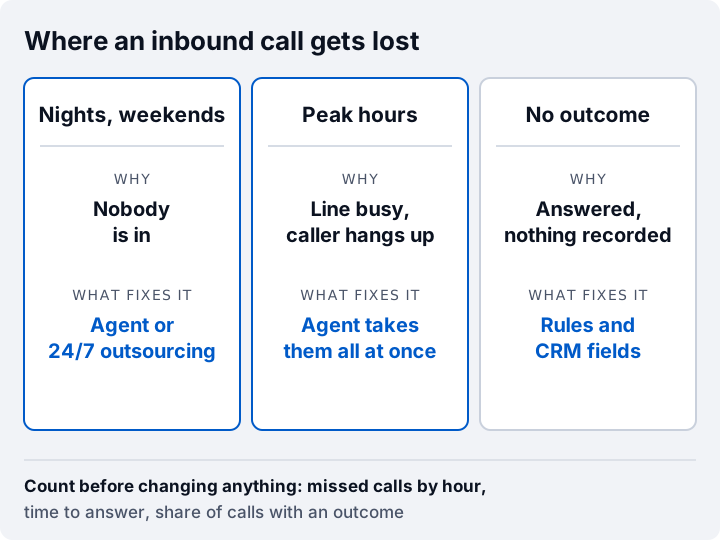
Calls are lost in three places, and only one of them is about the quality of the conversation.
Nights and weekends. The call comes in when nobody is there. Voicemail asks for a message, few leave one, and the ones left are not played back in the morning. People call when they have time, which is often the evening.
Peak hours. Monday morning, lunchtime, the day after a newsletter or an ad. The line is busy, the second and third callers hear ringing or music and hang up. A call missed at peak often goes to a competitor: the caller tried several places and chose whoever answered.
A call with no outcome. Someone picked up, answered, said goodbye. No booking, no request, no callback scheduled. In the report it is a "handled call"; in sales it is a lost one.
The first two are not about the script but about who can physically pick up. The third is solved by rules: how each type of call ends and where the outcome is recorded.
Which numbers show that call handling works?
Three numbers, counted before anything changes, or there will be nothing to compare against later.
The share of missed calls by hour and day of the week. Not one number for the month but a grid: Monday 9-10, Saturday 15-16 and so on. Almost any cloud PBX provides it. The monthly average can look tolerable while the grid shows that most evening and weekend calls are lost.
Time to answer. How long the caller waits for a live answer, including time spent in the IVR menu.
The share of calls with an outcome. A booking, an order, a request, a scheduled callback: something you can check later in the CRM. If calls are many and records few, the problem is not who picks up but how conversations end.
How do you count missed calls by hour?
You do not need a separate service. Almost any cloud PBX exports the call log: time, number, duration, answered or not. Then four steps.
- Export the log for at least two or three weeks, better a month, so both ordinary weeks and peak days are in it.
- Separate real misses from one-second drops. A call that ended on the first ring is often a misdial. A caller who waited twenty seconds and hung up is a lost customer.
- Check callbacks. If the missed number was called back within the hour and reached, it is a delay, not a loss.
- Build a grid of days by hours with the missed share in each cell. The dark cells usually gather in two places: evenings with weekends, and Monday morning.
Look separately at numbers that called several times in one day. Someone who dialled three times wanted to get through, and if they never did, that is the most expensive loss on the line.
What does a voice agent take on, and what stays with people?
An agent does well where a call repeats, the answer is already in the price list or rules, and the conversation ends with a clear outcome. Call types across three businesses are broken down in our note on voice bots for business. In short, for an inbound line: out-of-hours calls, where it competes with a missed call rather than with a colleague; peak hours, where it takes the calls that used to ring out; and repeat daytime questions about price, timing, address and status.
People keep haggling and exceptions, complaints, questions that need a specialist, and anything where a mistake is expensive. The agent collects the context on those calls and hands them over. On our demo on 9 October 2026 the agent started speaking 1.09 seconds after the caller stopped; where that second goes is covered in a separate note.
How do you choose a way to handle inbound calls?
| Person | Outsourcing | IVR | Voice agent | |
|---|---|---|---|---|
| Out of hours | No | If contracted | Routes only | Yes |
| Peak | One call at a time | If enough operators | Routes only | Yes, in parallel |
| Product knowledge | Best | From the script | Recorded phrases | Your rules and prices |
| Unusual question | Settles it | "We'll call back" | No | Hands over with context |
| How you pay | Salary | Per minute | PBX subscription | Build and support |
| Outcome in CRM | If remembered | As agreed | No | Every call |
Rule: if most calls are lost at night and at peak and the questions repeat, put a voice agent on those hours and call types and keep people for the hard cases. If calls are few and almost each one is unusual, a person with forwarding to a mobile is enough. If you need many live operators on a product with a simple script, compare outsourcing. If unsure, count missed calls by hour first; that usually decides it.
How does the agent hand a call to a person?
Handover is part of the scenario, not a failure. A good one: the agent tells the caller a colleague will join or call back at a stated time, and the caller does not have to repeat anything. The colleague who takes the call or the record already sees the name, number, the question and what the agent said. At night there is nobody to hand over to, so the agent records the question and states a callback time, and that promise has to match how the team actually works in the morning.
How do you launch a voice agent on an inbound line?
The questions we ask before an estimate are on the delivery page. In short: count the three numbers; pick one or two call types to start with; write the rules, including what the agent never discusses and when it hands over; name the CRM fields; connect telephony (the number you already publish stays the same); test on the real line, including hard conversations and mobile audio, covered in the note on two mobile legs; recount the same three numbers after two or three weeks.
We estimate a first working turnkey version for 20-30 simultaneous conversations at $25-40k, with support at $1.5-3k a month, telephony and licences separate (as of 9 October 2026). How the price adds up in the cloud and on your own servers is in the note on what a voice agent costs; what to test on a live call before buying is in the note on AI phone agents. For a shop line, see the note on a call centre for an online store.
Who does not need a voice agent on inbound calls?
- A handful of calls a day. The owner with forwarding to a mobile will cope, and the agent will not pay back.
- Almost every call is unusual. The agent will hand most of them over, and nothing is saved.
- No rules and nobody to write them. The agent answers by your rules; if the price is decided anew each time, agree on it internally first.
- Hardly any missed calls. If the line copes and calls end with an outcome, change the script and the CRM, not who picks up.
- You want the agent to pass as a person. Ours does not: it does not introduce itself as a bot, but answers honestly when asked.
The easiest way to hear such an agent on a line is to try it: in the demo you can call a pest-control firm, a dental clinic or an estate agency from your browser and try to interrupt it. If your line works differently, leave a request on the Voice AI page and we will go through it by the same three numbers.
Questions this raises
- What does inbound call handling include?
- Answering the call, finding out why the person is calling, answering or acting under the company's rules (a booking, an order, advice), recording the outcome in the CRM and handing the call to the right colleague when it cannot be settled on the spot. A separate part is what happens to a call when nobody can answer: at night, at weekends and at peak.
- Which inbound call metrics should I track?
- Three to start with: the share of missed calls by hour and day of the week, time to answer, and the share of calls that ended with an outcome such as a booking, an order or a scheduled callback. Other metrics are useful once these three are known.
- Can a voice agent replace people on an inbound line?
- No, and it should not try. It takes repeat calls and out-of-hours calls: price and timing questions, bookings, taking a request. Haggling, complaints and decisions someone is accountable for stay with people, and the agent hands those calls over with the context already collected.
- Will callers know they are not talking to a person?
- Often not from the voice. Our agent does not introduce itself as a bot at the start of a call, but answers honestly when asked directly and never claims to be human.