

Contents9 sections
Before you buyARTICLE
Auto Dialer: How the System Works and What to Set Up
An auto dialer is not one product but a system of two parts: dialing a list and the voice that speaks once someone answers. How it works, what you pay for, which outbound rules to check, how to launch a first campaign and which numbers to watch afterwards.
Costa7 min read
Short answer
An auto dialer calls the numbers on your list by itself and, once someone answers, hands the call to a recording, a scripted bot, an AI agent or a person. The bill is minutes plus whoever speaks: a recording or a scripted bot costs little beyond the minutes, an AI agent also needs rules and an implementation. Start with a small slice of the list and measure the outcome of the call, not the connect rate.
Key facts
- On 9 October 2026 the ElevenLabs Agents speech pipeline was priced at $0.080 a minute beyond the included allowance.
- We estimate a first working AI agent for 20-30 simultaneous calls at $25-40k turnkey and $1.5-3k a month in support.
- On a call to our demo on 9 October 2026 the AI agent answered 1.09 seconds after the caller stopped speaking.
An auto dialer is usually sold as a button: upload a list, press start, customers called. In practice it is a system of two parts worth choosing separately. The first dials: retries, detects voicemail, rotates the numbers it calls from. The second speaks after hello: plays a recording, follows a script, talks like a receptionist or transfers to a person. Most auto dialer pages describe the first part and a per-minute price. Below we go through both parts, the cost, the rules, the order of launch and the numbers that show whether a campaign works.
If you would rather hear the second part when an AI agent does the talking, call our demo.
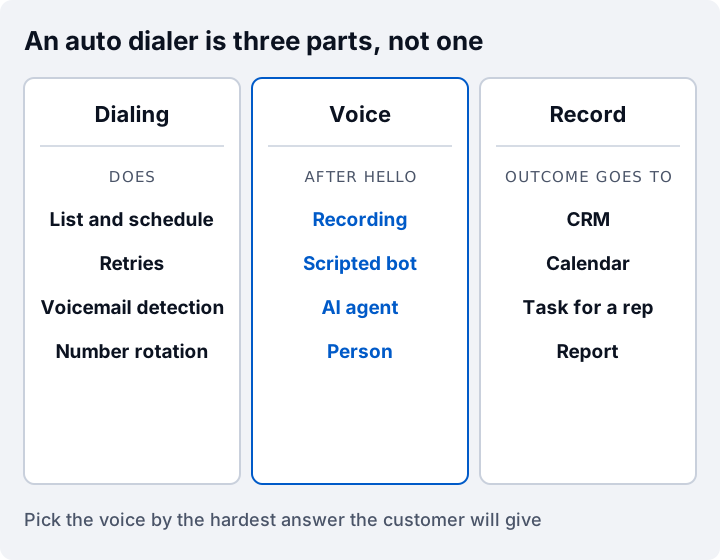
How does an auto dialer work?
Dialing. The system takes numbers from an uploaded list or from your CRM on a schedule and calls. If it does not get through, it retries after a set interval. If voicemail picks up, it detects it and hangs up or leaves a message. Good services rotate the numbers they call from so they do not end up in carriers' spam filters. This is infrastructure, and for mass campaigns there is rarely a reason to build it yourself.
Voice. Once a person answers, the call goes to whoever speaks: a recording, a scripted bot, an AI agent or a live agent the system transfers to. This part decides how the call ends, and it is the part people choose worst, because in the vendor's demo the customer always answers conveniently.
Record. After the call the outcome has to land where your team works: the CRM, the calendar, a task for a rep. A dialer that called well but left the result in its own dashboard creates more work: export, sort, re-enter.
We covered the three kinds of voice sold as a "robot" in Call robots compared. The one thing that matters here: choose the voice by the hardest answer the customer will give on that call.
What tasks suit an auto dialer?
Reminders and confirmations. An appointment tomorrow, a delivery, an order ready for pickup. The customer's answer is short or not needed. A recording with "press 1 to confirm, 2 to reschedule" works.
Short surveys. A service rating, whether a request is still open, a good time to call back. Answers are predictable and a scripted bot copes.
Calls with questions. Moving an appointment, a price question, "that's expensive". The script runs out on the first unexpected sentence, and you need an AI agent working from your price list and calendar, or a person.
Win-back and upsell. The customer has not bought in a while or their service is ending. Short calls, but the customer nearly always asks something of their own. Which of these to give a bot and which to keep for people is covered in Calling customers.
What does an auto dialer cost?
Minutes. Dialing services charge for call time. On short reminders the billing increment matters more than the headline rate: per second or rounded up to the minute, a minimum call length, and whether calls answered by voicemail are charged.
Voice. A recording takes an hour. A scripted bot needs someone to draw the script, test it against real answers and redo it when customers answer differently. An AI agent needs rules, a price list and access to the calendar and CRM, and its minute costs more because recognition, a language model and speech synthesis run on every one. The ElevenLabs Agents speech pipeline was priced at $0.080 a minute beyond the included allowance on 9 October 2026; the page does not say whether the language model is included.
Implementation. For an AI agent working to your rules, we estimate a first working version for 20-30 simultaneous calls at $25-40k turnkey and $1.5-3k a month in support, telephony and licences extra. If data may not leave for a cloud provider, the price changes again: the three delivery options are in What an AI voice agent costs and on the delivery page.
Compare the cost of an outcome, not of a minute: what one confirmed appointment or one returning customer costs.
What should you ask a dialing service?
How a minute is billed. Per second or per minute, minimum length, voicemail calls.
How voicemail is detected. Mistakes in both directions cost money: a live person treated as voicemail and dropped, or a message spoken into nothing.
Which numbers it calls from. Calls from one number end up in spam filters quickly and the connect rate drops.
When it may call. The service should respect the customer's time zone.
Where the outcome goes. A CRM integration or an API that writes the result to the customer record.
Where recordings are kept. For how long, who can access them, whether they can be exported.
Who should speak after connect?
The rule: choose by the hardest answer the customer will give on that call. No answer needed, a recording. An answer from a short list, a scripted bot. The customer will ask their own questions, an AI agent or a person.
| Campaign task | Recording | Scripted bot | AI agent | Person |
|---|---|---|---|---|
| Appointment reminder | Fits | Overkill | Overkill | Expensive |
| Confirm or reschedule | Confirm only | If options are few | Fits | Fits |
| 2-3 question survey | No | Fits | Fits | Expensive |
| Price and terms questions | No | Breaks | Fits | Fits |
| Win-back with objections | No | Breaks | Fits, hands hot leads over | Fits |
| Complex sale | No | No | Books the meeting only | Fits |
How do you launch a first campaign?
- Describe one task. Not "call the list" but "confirm tomorrow's appointments and reschedule those who can't make it".
- Clean the list. Remove duplicates, numbers without consent, customers who asked not to be called.
- Write the script from real answers. Listen to a dozen live calls on the topic first.
- Decide where the outcome goes. Before launch, not after.
- Run it on a small slice. A couple of hundred numbers show where the script breaks.
- Listen to recordings. Ten calls tell you more than a table of percentages.
- Fix and widen. Script changes after the first hundred calls are normal.
Which numbers to watch?
Connect rate, compared with your own campaign a week later rather than with vendor claims. Completed calls, and how many hung up on the second line. Outcome for the task, the only number that says whether the calling paid off. Transfers to a person and why. Complaints and opt-outs. And if an AI agent speaks, the pause before it answers: 1.09 seconds on our demo on 9 October 2026, broken down in Where the second goes.
Who is an auto dialer not for?
If you make dozens of calls, not hundreds, a person does them between other work. If you have no consent to call, it is a legal question, not a tool question. If the outcome has nowhere to go, the savings vanish into manual re-entry. And if every call is a negotiation, leave the money conversation to a person.
Where to start with an auto dialer
Pick one task with more calls than your people can handle and a predictable customer answer: confirmations, reschedules, reminders. Run it on part of the list, listen, count the outcome. If the task needs a voice that answers questions, call our demo; how we put such an agent on your line is on the Voice AI page, and which calls to hand to a bot is in Voice bot for business.
Questions this raises
- What does an auto dialer cost?
- Minutes from the dialing service, plus whoever speaks after connect. A recording or a scripted bot adds little beyond the minutes. An AI agent working to your rules adds an implementation: we estimate a first version at $25-40k.
- How is an auto dialer different from a call robot?
- The dialer's job is to get through: dialing, retries, voicemail, numbers. The robot's job is what happens after hello. They are two parts of one system and can be chosen separately.
- Is auto dialing legal?
- Rules on automated and marketing calls differ by country and usually depend on consent. Service calls to customers who gave you their number are common practice; anything promotional should be checked with a lawyer for your market before launch.
- Can an auto dialer sound like a real person?
- A recording sounds like a recording and a scripted bot gives itself away by the second line. An AI agent speaks in its own words, but ours tells the truth when asked directly that it is an AI and never claims to be human.